This week I watched a "Santa" movie, and I didn't hate it! Normally Santa movies annoy me. They annoy me a lot. They always seem to recycle the same jokes, and they are always full of "Holiday Cheese." Not this one. "Rise of the Guardians" is probably the best "Santa" movie. I've ever seen.
Granted, when I first heard about it, I expected an epic fail of lame-ness. In a nutshell, the plot is this:
Jack Frost teams up with Santa Claus, The Easter Bunny, The Tooth Fairy and the Sandman, to fight the Boogeyman, who is giving all the children of the world nightmares. That to me sounded like the lamest movie plot ever, and I did not want to see it. At all. Then I started seeing trailers.
I had to admit, it didn't look half bad. My cousin Sasha really wanted to go see it. She recognized it as based on a book series she had seen and said it was really good. After I saw another trailer in the theater, I was finally convinced to go with her. I am really glad I was. The movie is so much better than it sounded.
When I first heard about it I assumed that it was all about Santa, which as you may have guessed was a complete turn off for me. I did not want to watch another Christmas Santa movie. But that assumption was wrong. First off, it's not even a Christmas movie, it just happens to have Santa in it. Also, Santa was only one of four SIDE characters, and the MAIN character was Jack Frost. But even if Santa had been the star, it would have been cool. This was no Jolly elf with a chubby tummy, going Ho-Ho-Ho. This Santa is a massive, muscular Russian. He has Tattooed arms, and he fights with two swords. I'd watch a movie about this guy even without the other characters. None of that was even the best part about him though. Most Santa stories have the elves making all the toys. Not this Santa. This Santa claims that he just lets the elves THINK they are making the toys. They are pretty much little walking, giggling sight gags, like Christmas versions of the minions on Despicable Me. The real toy makers are a massive army of Yeti. My inner Cryptozoologist is quite pleased with this. :)
The other characters are all much "Cooler" than normally portrayed as well.
First up, the Easter Bunny. He's not a fluffy little cottontail bunny. He's a giant Australian Jackrabbit with an attitude.
The Tooth Fairy is not your regular princess/ballerina/fairy in a TuTu either. She seems to be part hummingbird, and she has thousands of much tinier hummingbird-fairies to help her with her job, which turns out to be about more than just collecting teeth.
The Sandman still seems a little on the chubby and cute side of the scale, but his powers make up for it, and he turns out to be very cool in his own way. (Dinosaurs + Manta Rays = Awesome. :) )
Jack Frost has been portrayed in many ways over the years, but this version is the best. He's kind of a rebellious teen/punk type of character in the beginning, despite the fact that he's about 300 years old, but by the end he's become a full on hero. There was actually a lot of depth to his back-story and character development, something you don't normally get out of a "Kids" movie.
The Boogeyman, AKA, Pitch Black, also turns out to be a great Bad Guy. They could have made him out to be a "Silly" sort of villain, but they did not, he ended up being a dangerous and formidable foe, and the film was much better for that.
All in all, I really enjoyed this movie. If you have kids, or just like animated films yourself, I highly recommend this one. :)
Showing posts with label Yeti. Show all posts
Showing posts with label Yeti. Show all posts
Saturday, November 24, 2012


Thursday, December 15, 2011
Legendary Creatures Around the World
I have been working Extremely hard these last two weeks getting everything completed for all my classes. Last week I finished an almost 6 page report on Legendary Creatures for my Geography class. I just checked on my grade and aside from a couple “Grammatical Errors” which he did not point out, I aced it. Generally the teachers in the online classes do not write much for reviews, but my teacher did have a rather complimentary, if brief bit of praise to offer.
I know some of you have enjoyed reading my other things about cryptozoology, so I will share my paper here for those of you who would like to read it. :)
So far one of my favorite papers since I've been teaching this class (3 years now). I enjoyed the subject matter immensely.I now have a final exam to complete, and then I will be completely finished with this class, and as this test is the last thing I need to complete for any class, I will soon be done with all of this semester’s work. Woo Hoo!
I know some of you have enjoyed reading my other things about cryptozoology, so I will share my paper here for those of you who would like to read it. :)
Legendary Creatures Around the WorldBy Jonathan NorthThe deep forests in the North America, the deserts of the Australian outback, the icy depths of a Loch in Scotland, the snowy peaks of the Himalayan Mountains in Asia, and the dense jungles of the African rainforests; all these are places today that have significant legends attached to them, legends of fantastic creatures. Creatures laughed off by most as just stories or superstition. But what if these stories are more than just stories? What if these creatures all really exist?
Today there are creatures in zoos all over the world that were once laughed at as creatures of myth and legend. Kangaroos, pandas, and many other creatures at one time were disregarded as myths by the scientific community until given absolute proof. In fact, one of my favorite animals was considered a myth until the late 18th century when Europeans were first introduced to a living giraffe. They had heard of giraffes from ancient Greek and Roman writings, but having never seen such a beast for themselves, it was thought to be an animal that the ancients had invented. Similarly, the giraffe’s only known relative, the okapi, was also thought to be a myth until its official discovery in the late 1800’s by Sir Harry Johnston. In 1903 the first live Okapi was captured, and today you can find them in zoos all over the world.
When explorers brought the remains of a platypus to England from Australia they were accused of creating a fake animal by piecing together parts from the bodies of real animals. It was not until sometime later when scientist saw for themselves living, breathing specimens, that they accepted that the platypus was not a beaver with a duck’s bill taxidermied to its face.
Some scientists think there is a definite possibility that there is truth behind our modern day myths, and have dedicated their lives to trying to prove them as truth. These scientists, working in the relatively small, and often maligned scientific field of Cryptozoology, the study of unknown animals, ask a very simple question. Is it possible that mythological creatures have some basis in reality? While it is unlikely that all these animals are exactly as the stories depict them, I fully believe that for every legend there is, or was, a real, live creature behind it.
All over the world, and throughout the ages of time, every culture has stories of fantastic beasts that great warriors fought and killed. When the great beasts are called a bear or a lion, it is generally accepted that such a story truly happened. The hero’s deeds may be exaggerated for dramatic effect, but generally such stories are thought to have a grain of truth to them. But what about the stories with a creature we don’t recognize?
Many countries and many cultures all over the world had legends of monstrous and unbelievable beasts. Native Americans told of massive birds with such huge wingspans they created thunder as they flew. Sailors have long told stories of encounters with strange creatures, such as mermaids, and fearfully large creatures, from the massive Kraken to enormous sea serpents that would attack ships and drag them to the ocean floors never to be seen again. And many, many cultures have legends of gigantic reptiles called dragons. But these were all just stories, right? Maybe, but legends had to start somewhere.
What if these legends were stories that these cultures used to explain real life animals that they did not understand? It is generally accepted now, that the legend of the Kraken might have been based on encounters with giant squid, an animal undocumented by science until recent years. Similarly the stories of mermaids, may have come from sailors, dehydrated and not able to see straight, who saw sunbathing seals, or swimming manatees. Why is it so different to believe that a story of a dragon was based on a real animal?
While this explanation is usually laughed off by mainstream scientists, Creation scientists have hypothesized that the dragon legends of cultures all around the world, from ancient Babylon, to ancient China, to even more recent examples like the medieval European legend of St. George and the Dragon, were based on encounters with dinosaurs.
Since Creationists see fossils as evidence of a world-wide flood in the days of Noah, they see no problems in believing that dinosaurs were alive at the time of man. They obviously would not have been called dinosaurs, a name coined only in 1840 by Sir Richard Owen, but could they have been known by the name dragon, or other names throughout history, depending on the culture who tells the tale? Since most Dragon legends end with the dragon slain by the valiant hero, perhaps the reason for the dinosaur’s extinction was the same reason that so many species are in danger of going extinct today; us. Humanity is generally thought to be the cause of the Mammoth’s extinction. Humanity caused the Dodo’s extinction. Humanity wiped out the Passenger Pigeon, the Moa, and the Tasmanian Tiger. If the dinosaurs did not go extinct millions of years ago, is it such a stretch to believe that we caused their extinction?
Some people, not just creationists, even believe that some dinosaurs may still be alive, as there are stories all around the world to this day of creatures that fit the descriptions of dinosaurs. There are stories of multiple creatures in Africa, the most famous of which, the Mokele Mbembe, fit the description of a living dinosaur. Australia also has stories, as do the Native Americans here in our own country. Ancient artwork occasionally depicts creatures that do not resemble any known creature today, and some of them look vaguely like dinosaurs.
But dinosaurs are not the only creatures around which legends might be based. All over North and South America, there are legends of giant hairy ape men. To the natives in Canada, these creatures were known as Sasquatch. To Americans, who more often use the name in derision, the creature is known as Bigfoot. In South America they tell tales of the Mono Grande, “Big Monkey”, a giant tailless ape.
Without solid proof, people who claim to have seen such creatures are laughed at, but to scoff at such stories has often left the scoffers with egg on their faces. Until about 200 years ago the scientific community laughed at African natives who claimed that giant, hairy, wild men lived in the jungles of Africa. Their laughter turned to astonishment when a French explorer brought back the body of a gorilla. Is it so difficult to believe that similar creatures could exist on one or both of the Americas?
Similar to these stories is the Abominable Snowman in Asia, or as the native people refer to him, the Yeti. A wild man said to live in the Himalayas. Is it possible that this “wild man” is a type of ape? In Australia, they tell of a creature called Yowie, and their descriptions are also of a hairy ape man. To me, so many similar stories all over the world, can’t be laughed off as coincidences.
Another famous beast, beloved by tourists and derided by scientists, is the Loch Ness Monster a giant beast said to live in the Loch Ness in Scotland. Most accounts told of the creature describe it as what looks to be an extinct marine reptile, similar to a plesiosaur. Scientists say that there is no way it can exist there, but researchers have found evidence of underwater caverns that may contain air, and channels that could lead to the ocean. Who’s to say that “Nessie” is just one creature? Isn’t it far more likely that what people have seen throughout history are just different members of the same species? Perhaps the Loch is just a stop on their migratory rout?
The Loch Ness is not the only body of water said to contain a monster, in fact there are stories of lake monsters all over the world. However, one lake, Lake Champlain, a lake between New York and Vermont, has been the only place other than Loch Ness for someone to provide somewhat credible evidence for the existence of such a creature. In July of 1977 a woman captured an image of the beast that is still debated today. The image shows what appears to be a plesiosaur, even clearer than the ones taken of Nessie. This was in the days long before Photoshop, so the chances that this woman was able to fake this photograph by herself are quite slim.
We humans love stories. We love hearing tales of the unknown, and stories of creatures that couldn’t possibly exist. But every story had to be inspired by something. I think it is completely within the realm of possibility that all these stories, all over the world, told by cultures throughout history, had some basis in truth. After all, The Gorilla, the Panda, and the Giraffe were once stories. Perhaps someday, our descendants will stroll through the zoo and laugh at us because we once thought that Sasquatch and Nessie were figments of someone’s overactive imagination.
Saturday, December 10, 2011
2 Countries 8 Facts
I am getting down to the final stretch! Next week is finals week and I have been studying harder than ever this week trying to get ready. Today I never left my room, except for, you know, eating and stuff… I’m still in my pajamas from last night, and it is currently… Um… Very, very late at night… Again… :p But it was all worth it because I completely finished a huge research paper and an assignment for Geography where we were to find 4 facts each about two different countries. (Though because I am somewhat of a nerd, I beefed up all the facts, so they each contain a bunch of sub-facts. Maybe I’ll get bonus points! :D ) The countries could be anywhere in South America, Europe, Asia, or North Africa. Since I know you are all dying for some interesting Geographical trivia, ;) I decided to share my findings with all of you. Aren’t you excited? Hooray for knowledge! :D
For my first country I chose Latvia, as I have friends whose family immigrated from Latvia, one of whom has now returned, having married a Latvian, and they are currently raising a family there. The second country I chose purely because I wanted to incorporate some aspect of Cryptozoology into my report. I chose Nepal, because it is one of the two counties in which the Himalayas are located. The Himalayas being the home of the Yeti, or Abominable Snowman. :p
You guys are all lucky because, as this is my blog, I decided that I would illustrate my report for you. So much more interesting than the one my teacher has to grade! :D
Latvia

The name Latvia is spelled Latvija in the Latvian language and this comes from the ancient Latgallians, or Letts, one of four tribes, who formed the ethnic core of today’s Latvian people. In written sources, they are first mentioned in the 11th century, but not much is known of the origins of these tribes.
One of the staples of the Latvian diet is Rupjmaize, a dark bread made from rye.

Using rye bread for something other than sandwiches would be pretty unheard of here in the U.S., but in Latvia, it is used to make Rupjmaizes kartojums, a traditional Latvian dessert. Layered like a trifle, this dessert uses jam or preserves, along with a rye bread crumb mixture and whipped cream.

Often it is garnished with more bread crumbs and fresh fruit to give it an attractive appearance.
Latvia's national bird is the White Wagtail, so named for the way its tail moves as it runs along the ground.

No one knows why the wagtail is constantly wagging its tail, but reasons for it have been hypothesized, from a submissive signal to other wagtails, to a sign of vigilance that deters predators.
Although the origins of the Christmas tree are disputed by historians, one of the first documented uses in history is from Latvia. In 1510 an evergreen was erected for their celebration in the town hall square in Riga, Latvia.
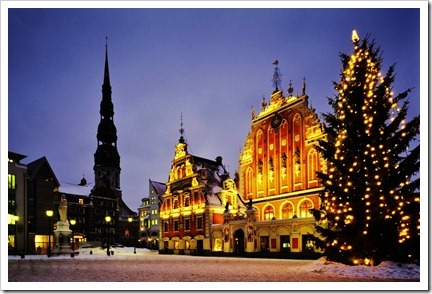
The grandest building on the square, the House of Blackheads has a domed plaque in front of it, marking the location of this first celebration.
Nepal

Early sources refer to the country as Nepala, and the name Nepal is believed to come from the word "Nepa" referring to the Newar Kingdom, which is the present day Kathmandu Valley. Local legends say that a Hindu sage named "Ne" came to the valley in prehistoric times and that the word "Nepal" means, "The country looked after by Ne".
Nepal contains some of the highest mountain peaks on earth. One of these mountains is Mount Everest, which is the highest mountain in the entire world.

Although the height is disputed and Nepal is planning a new survey, the current accepted height of the mountain is 29,029 ft. The mountain is the home of what may be the highest non-microscopic life form on earth, the Euophrys omnisuperstes, a tiny jumping spider.

It is thought that the spider may feed on small frozen insects blown there on the wind.
Nepal's flag is the only national flag in the world that is not rectangular in shape.

The red in the flag stands for courage, and is the color of the rhododendron, the national flower of Nepal, and the flag's blue border signifies peace. The curved moon on the flag is a symbol of the calm nature of the Nepalese people, while the sun represents the aggressiveness of the Nepalese warriors.
Nepal is one of two countries said to be the home of one of the most famous legendary monsters of today, known as the Yeti, or, more popularly, the Abominable Snowman.

The Yeti is said to live in the Himalayas, a mountain region spanning both Nepal and Tibet. The name Yeti comes from a Tibetan word for bear, as some believe that the Yeti is a Man-Bear. Most descriptions given of this creature make it out to be a giant ape, similar to the Bigfoot or Sasquatch of North America.


So, there you have it. All you never knew you needed to know about Latvia and Nepal. :)
Subscribe to:
Posts (Atom)